Showing posts with label election. Show all posts
Showing posts with label election. Show all posts
Saturday, January 16, 2010
All Flags at Half-Mast. One more quotation from the President of Ukraine.
“If Yulia Tymoshenko is getting into the second round, it will be the time to go to Maidan and dip the national flag”, the President of Ukraine Viktor Yushchenko said during one famous TV-show on 15 January 2010.


Friday, January 15, 2010
There is a threat to Independence and Integrity. President Yushchenko addressed Ukrainian citizens.
Today on 21.00 the President of Ukraine Viktor Yushchenko has made an extraordinary address to the citizens of Ukraine, translated by all the national TV and radio channels.
“January the 17th may become the day, when country will be pushed to backward direction”, Viktor Yushchenko said. Among the main threats President mentioned “a threat of energy dependence and loss of the influence to the gas transit system”, “a debt load of tens of billions dollars”, “a threat of reconsideration and postponing the European direction”, and “a threat to the integrity and sovereignty” of Ukraine.
Also President has emphasized a threat of the falsification of voting results.
Viktor Yushchenko appealed to election commissions at every polling place (to respect the rule of law), to judges (“you will play the unique role”), and to the ‘shoulder-strap people’ (“your duty is to defend the people’s choice”).
“January the 17th may become the day, when country will be pushed to backward direction”, Viktor Yushchenko said. Among the main threats President mentioned “a threat of energy dependence and loss of the influence to the gas transit system”, “a debt load of tens of billions dollars”, “a threat of reconsideration and postponing the European direction”, and “a threat to the integrity and sovereignty” of Ukraine.
Also President has emphasized a threat of the falsification of voting results.
Viktor Yushchenko appealed to election commissions at every polling place (to respect the rule of law), to judges (“you will play the unique role”), and to the ‘shoulder-strap people’ (“your duty is to defend the people’s choice”).
Tuesday, January 12, 2010
From 10 to 15 percent of votes may be fabricated during the presidential election – MP of the Yulia Tymoshenko faction
The idea of using the courts in making the decision on the result of the election of the President of Ukraine, using the 2004 scenario, is widely promoted by Ukrainian politicians these days. Especially by the political team of the Prime Minster of Ukraine Yulia Tymoshenko.
In particular, Sergiy Sobolev, Member of Parliament of Ukraine from the Block of Yulia Tymoshenko, said to the journalist of Ukrainian 5th TV channel on 11 January 2010 that ‘up to 10 percent of votes may be falsified’. ‘If we take to the account those voters who will vote at several polling places (which is possible due to some essential ‘holes’ in law on presidential election – T.V.), the fraud may raise up to 15 percent’, Mr. Sobolev added.
In particular, Sergiy Sobolev, Member of Parliament of Ukraine from the Block of Yulia Tymoshenko, said to the journalist of Ukrainian 5th TV channel on 11 January 2010 that ‘up to 10 percent of votes may be falsified’. ‘If we take to the account those voters who will vote at several polling places (which is possible due to some essential ‘holes’ in law on presidential election – T.V.), the fraud may raise up to 15 percent’, Mr. Sobolev added.
Monday, January 11, 2010
Expected Fraud. Is Yulia Tymoshenko preparing a ground to declare the results of presidential election as a fake?
The BYT (Block of Yulia Tymoshenko) parliamentary faction has accused the Central Election Commission in taking the decision, which will lead to the mass falsifications during the election of the President of Ukraine.
‘Controlled by the party of Regions majority at the Central Election Commission made a decision of 4 January this year on the procedure of vote at home, and inclusion of voters into the voter registers on election day, which contravenes the democratic standards for holding elections’, is said in today’s official statement of the BYT faction. ‘In such a way members of CEC, who are close to the Party of Regions, had de facto opened the unlimited opportunities for use of the mass fraud during the election of the President of Ukraine’.
“There is no doubt: the establishment of Viktor Yanukovych doesn’t believe in victory of its candidate in free and transparent election”, members of the Block of Yulia Tymoshenko declared.
By the way, all Ukrainian polls stated that the rating of Mr. Yanukovych is bigger than Ms. Tymoshenko’s one on 7-15%.
The BYT faction has proposed to hold an extraordinary sitting of the Parliament of Ukraine on 13 January – to change some procedures of vote, approved by the CEC, ‘to prevent fraud’. One shouldn’t be an expert to predict that the Parliament will fail to adopt any changes. But the fact of putting the question of electoral procedures on vote will surely give to one of the presidential candidates an extra-right to declare the result of vote on 19 January, and especially on 7 February (2 round), as a fraudulent.
Viktor Yanukovych has already commented the BYT initiative, saying that ‘we will fight, and we will not permit to make a decision on the result of election in courts’. But it seems to me that there may be a third round of election of the President of Ukraine – in the Arbitration Courts.
‘Controlled by the party of Regions majority at the Central Election Commission made a decision of 4 January this year on the procedure of vote at home, and inclusion of voters into the voter registers on election day, which contravenes the democratic standards for holding elections’, is said in today’s official statement of the BYT faction. ‘In such a way members of CEC, who are close to the Party of Regions, had de facto opened the unlimited opportunities for use of the mass fraud during the election of the President of Ukraine’.
“There is no doubt: the establishment of Viktor Yanukovych doesn’t believe in victory of its candidate in free and transparent election”, members of the Block of Yulia Tymoshenko declared.
By the way, all Ukrainian polls stated that the rating of Mr. Yanukovych is bigger than Ms. Tymoshenko’s one on 7-15%.
The BYT faction has proposed to hold an extraordinary sitting of the Parliament of Ukraine on 13 January – to change some procedures of vote, approved by the CEC, ‘to prevent fraud’. One shouldn’t be an expert to predict that the Parliament will fail to adopt any changes. But the fact of putting the question of electoral procedures on vote will surely give to one of the presidential candidates an extra-right to declare the result of vote on 19 January, and especially on 7 February (2 round), as a fraudulent.
Viktor Yanukovych has already commented the BYT initiative, saying that ‘we will fight, and we will not permit to make a decision on the result of election in courts’. But it seems to me that there may be a third round of election of the President of Ukraine – in the Arbitration Courts.
Sunday, January 10, 2010
Political ZOO. White Bengal Tiger as a symbol of a presidential electoral campaign in Ukraine.

“Promise me you'll never forget me, because if I thought you would, I'd never leave.” Winnie the Pooh.
I am back to blogging since yesterday, and the same day the President of Ukraine gave me a reason to start this subject - the Tiger topic in Ukrainian politics.
While giving a speech in frames of his visit to Cherkassy region, Viktor Yushchenko – as usually – strongly criticized the Prime Minister of Ukraine Yulia Tymoshenko. Moreover, he proposed to the PM to leave the Ukrainian politics. Answering a question on the not-adopted-Budget-of-Ukraine for 2010, President, in particular, said: “It is time for her to have a rest, at least for a little bit, because every month of her work brings a colossal poverty to our country. Let her roll on the floor with the tiger, so far to end her working way in Ukrainian politics”.
I would love not to comment the quotation, but to tell more about The Tiger.
On 24 August, 2009, the Prime Minister of Ukraine Yulia Tymoshenko visited the popular child festival “Black Sea Games” in Crimea. During the visit PM received an original gift – a Bengal tigress of a white color. By the way, they say, the unique White Tiger on the territory of Ukraine.
Re-presented to the Yalta zoo, the tigress named TigerYulia (‘tigrulia’ in Ukrainian transcription) was not abandoned and forgotten. The symbol of 2010 according to the Chinese calendar, the White Tiger became a very active ‘face’ of the presidential campaign of the Prime Minister.
I am back to blogging since yesterday, and the same day the President of Ukraine gave me a reason to start this subject - the Tiger topic in Ukrainian politics.
While giving a speech in frames of his visit to Cherkassy region, Viktor Yushchenko – as usually – strongly criticized the Prime Minister of Ukraine Yulia Tymoshenko. Moreover, he proposed to the PM to leave the Ukrainian politics. Answering a question on the not-adopted-Budget-of-Ukraine for 2010, President, in particular, said: “It is time for her to have a rest, at least for a little bit, because every month of her work brings a colossal poverty to our country. Let her roll on the floor with the tiger, so far to end her working way in Ukrainian politics”.
I would love not to comment the quotation, but to tell more about The Tiger.
On 24 August, 2009, the Prime Minister of Ukraine Yulia Tymoshenko visited the popular child festival “Black Sea Games” in Crimea. During the visit PM received an original gift – a Bengal tigress of a white color. By the way, they say, the unique White Tiger on the territory of Ukraine.
Re-presented to the Yalta zoo, the tigress named TigerYulia (‘tigrulia’ in Ukrainian transcription) was not abandoned and forgotten. The symbol of 2010 according to the Chinese calendar, the White Tiger became a very active ‘face’ of the presidential campaign of the Prime Minister.
At first, on the 1st of September 2009 a lot of Ukrainian schoolboys and schoolgirls received new school diaries and notebooks with the image of TigerYulia with the famous braid on her (tigress’) head.
Then TigerYulia appeared on the billboards of the PM before and after the New Year.
Then TigerYulia appeared on the billboards of the PM before and after the New Year.
By the way, Viktor Yushchenko also used a symbol of Tiger in his political PR. At the end of 2009, the press service of the President informed that the beloved cat of the President, named Tiger, run away from the country house of Viktor Yushchenko. TV-journalists immediately offered a helping hand to the Tigerless President – almost the same day he got a new little cute kitty, which probably received a different name.


FT.com / Comment / Editorial - Ukraine’s dilemma
And here is the FT-editorial view on the situation in Ukraine, in rather interesting tone:
Five years ago, Ukraine’s presidential elections captured the imagination as Viktor Yushchenko emerged triumphant.Copyright The Financial Times Limited 2010. Link to the article: FT.com / Comment / Editorial - Ukraine’s dilemma
On Sunday, Ukrainians vote in the first presidential election since 2004 and in very different circumstances from the Orange Revolution. Mr Yushchenko’s failure to create stability, fight corruption or protect citizens against a rapacious bureaucracy has created widespread disillusion.
The gloom is compounded by the economic crisis, which has forced Kiev into an International Monetary Fund rescue programme.
Despite the political chaos, the Orange Revolution’s legacy has survived in a free media, openness to the outside world, and multi-party competition. Despite constant Russian interference, Ukraine’s sense of identity as an independent state has grown. And, despite the economic crisis, Ukraine is a richer place than five years ago, with a better stock of housing, cars and consumer goods.
But Mr Yushchenko’s political failures have left voters with a lamentable electoral choice. He stands no chance of retaining office. The top contenders are Viktor Yanukovich, the opposition leader, and Yulia Tymoshenko, the prime minister, Mr Yushchenko’s 2004 ally but now his bitter rival.
It is humiliating for Ukraine that Mr Yanukovich, whose 2004 presidential campaign was widely seen as fraudulent, has not been hounded out of politics. He has survived thanks to a cynical political culture and the backing of big business. Even Mr Yushchenko has done deals with him.
Ms Tymoshenko should, in principle, be a more attractive choice, given her Orange credentials. But she has proved herself shamelessly opportunistic and shares the blame with Mr Yushchenko for the failures of the Orange camp. Her economic policies show a unnerving penchant for populist intervention, eg with arbitrary price caps.
In international affairs, both would balance ties with Russia with a slow push for European Union integration. Not much to choose between Ms T and Mr Y on this score.
So, whom to back in Sunday’s first round and next month’s run-off? Given the candidates’ shortcomings, voters must focus on what is important. The key now is political stability. Only a stable Ukraine can achieve economic reform and recovery. Ms Tymoshenko is the polar opposite of a stabilising force. Mr Yanukovich, for all his manifest faults, may prove the lesser evil. Pity Ukraine that it has come to this.
A Zero-Wind Chill. Only 7 days left before the presidential election in Ukraine.
Celebration of the New Year and the Orthodox Christmas has lowered the speed of the electoral campaign in Ukraine. All the major candidates were actively present at Ukrainian media-space with colorful video greetings, and on thousands of billboards near the main roads all over the country, but there was no sign of a real fight. One week before election, and a total calmness of a political sea.
The zero-wind air conditions may be caused by the predictability of the result of the first round of the election (17 January 2010). It is obvious that two winners who will meet in the second tour on 7 February 2010 are Prime Minister Yulia Tymoshenko and the leader of the biggest opposition Party of Regions Viktor Yanukovych. The distance between them is predicted to be around 10-12 percent, not in favor of the lady.
It seems that nothing may change the current correlation of political forces during the next week (though, it would be interesting to follow the last speeches of all the main pretenders to the presidential power, and I will do my best to share my impressions here, taking a week-off in the office). The most interesting developments are expected to happen within a time-frame between the first and second rounds, and also after the 7th of February – on the streets and in courts.
The zero-wind air conditions may be caused by the predictability of the result of the first round of the election (17 January 2010). It is obvious that two winners who will meet in the second tour on 7 February 2010 are Prime Minister Yulia Tymoshenko and the leader of the biggest opposition Party of Regions Viktor Yanukovych. The distance between them is predicted to be around 10-12 percent, not in favor of the lady.
It seems that nothing may change the current correlation of political forces during the next week (though, it would be interesting to follow the last speeches of all the main pretenders to the presidential power, and I will do my best to share my impressions here, taking a week-off in the office). The most interesting developments are expected to happen within a time-frame between the first and second rounds, and also after the 7th of February – on the streets and in courts.
Thursday, October 29, 2009


Monday, October 26, 2009
The Endless Circle. Ukraine may have snap parliamentary poll in May 2010.
Ukraine may expect the comeback of a ghost of an early parliamentary election in 2010. This secret is widely known as after the presidential election in January-February 2010, the winner (whoever it will be) would surely want to take it all, and to form the majority in Parliament using the effect of his recent victory.
The same point of view has confirmed Volodymyr Lytvyn, Chairman of the Parliament of Ukraine and a newly registered presidential candidate. In May 2010 Ukraine will have snap parliamentary election, he told journalists today.
He emphasized that ‘under the current circumstances in Parliament, a lot of problems will appear’, that’s why the new President will surely try to nail down a success. The key position in country will be the Prime Minister’s office, Mr. Lytvyn added.
The same point of view has confirmed Volodymyr Lytvyn, Chairman of the Parliament of Ukraine and a newly registered presidential candidate. In May 2010 Ukraine will have snap parliamentary election, he told journalists today.
He emphasized that ‘under the current circumstances in Parliament, a lot of problems will appear’, that’s why the new President will surely try to nail down a success. The key position in country will be the Prime Minister’s office, Mr. Lytvyn added.
Thursday, October 22, 2009
Tuesday, October 20, 2009
Get ready, get set, go! Ukraine officially launched a presidential election campaign on Monday. Today the nomination of the candidates starts.
Last time Ukraine elected president in 2004, when, after the Orange revolution, Viktor Yushchenko came to power, accusing his main rival Viktor Yanukovych in the falsification of the results of the previous tour of election. Now the situation has changed dramatically: according to polls, Mr. Yanukovych is a leading contender. Viktor Yushchenko – on contrary – may try to use his presidential administrative resource during his campaign, experts say.
The second rating has another hero of Orange revolution – the Prime Minister of Ukraine Yulia Tymoshenko. Third – ex-Head of Parliament, and ex-Minister for Foreign Affairs Arseniy Yatseniuk.
Other pretenders are former Head of the National Bank of Ukraine Sergiy Tigipko, current Speaker of the Parliament Volodymyr Lytvyn, Communist party leader Petro Symonenko, and radically right politician Oleh Tyagnybok.
The nomination of the candidates starts today, on 20 October 2009, and will last until 6 November. The last day for the documents’ submission to the Central Electoral Commission is the 9 of November. The CEC has to register all the candidates until 13 November 2009.
The second rating has another hero of Orange revolution – the Prime Minister of Ukraine Yulia Tymoshenko. Third – ex-Head of Parliament, and ex-Minister for Foreign Affairs Arseniy Yatseniuk.
Other pretenders are former Head of the National Bank of Ukraine Sergiy Tigipko, current Speaker of the Parliament Volodymyr Lytvyn, Communist party leader Petro Symonenko, and radically right politician Oleh Tyagnybok.
The nomination of the candidates starts today, on 20 October 2009, and will last until 6 November. The last day for the documents’ submission to the Central Electoral Commission is the 9 of November. The CEC has to register all the candidates until 13 November 2009.
Friday, September 18, 2009
The Constitutional Threat. The election of the President of Ukraine, scheduled on January 2010, may be wrecked by the Constitutional Court ruling.
The President of Ukraine Viktor Yushchenko appealed to the Constitutional Court of Ukraine on Monday, 14 October 2009, to examine the compliance of some clauses of the Law of Ukraine on the amendments to the Law on Presidential Elections (recently adopted by Parliament) with the Constitution of Ukraine. A lot of experts predict it may cause the disruption of the Presidential election, scheduled for the beginning of 2010.
If the Constitutional Court declares that some provisions of the law are unconstitutional, the Presidential election of January 2010 will be put in jeopardy – for sure. Parliament will definitely fail to pass the amendmends to the Law (due to the requirements of the Court) before the official starting date of the presidential race – 19 October 2009. Then it will be easy to question any result of the vote if it happens on 17 January: as the election was organize according to the “old”, unconstitutional version of the law. The only way to stay within the frames of a Fundamental law of the country will be to schedule a new date for the presidential election, extending the term of office of Viktor Yushchenko.
The Speaker of the parliament of Ukraine Volodymyr Lytvyn has recently said that he is ‘convinced that there are reasons for the Constitutional Court to define some clauses of the law as unconstitutional’. He thinks it may cause a political turbulence and lengthy court battles over the election, making the situation ‘disorganized’.
The “new version” of the Law of Ukraine ‘On Presidential Elections’, in particular, reduced the time of presidential campaign from 120 to 90 days. It also allowed adding people to voter lists on the day of election (as the clear and trustable Voter Registry has not been formed in Ukraine yet), and prohibited to vote for Ukrainians living overseas, if they are not included to the Consular register (these legislative innovations are mentioned in the President’s application as one may cause a huge fraud, and another restricts the citizens’ universal right to vote).
Pre-history: On July 24, 2009 the Parliament of Ukraine passed a bill amending the Law on Presidential Elections. On 18 August Viktor Yushchenko vetoed the proposed amendments on the Law on Presidential Elections. But the Parliament convened a special session on August 21, when 325 out of 371 members of parliament override the president's veto.
The presidential election is scheduled for January 17, 2010. If required a second round ballot is expected to take place in February 2010. The President of Ukraine is elected by the citizens of Ukraine for a five-year term, on the basis of universal, equal and direct suffrage, by secret ballot.
If the Constitutional Court declares that some provisions of the law are unconstitutional, the Presidential election of January 2010 will be put in jeopardy – for sure. Parliament will definitely fail to pass the amendmends to the Law (due to the requirements of the Court) before the official starting date of the presidential race – 19 October 2009. Then it will be easy to question any result of the vote if it happens on 17 January: as the election was organize according to the “old”, unconstitutional version of the law. The only way to stay within the frames of a Fundamental law of the country will be to schedule a new date for the presidential election, extending the term of office of Viktor Yushchenko.
The Speaker of the parliament of Ukraine Volodymyr Lytvyn has recently said that he is ‘convinced that there are reasons for the Constitutional Court to define some clauses of the law as unconstitutional’. He thinks it may cause a political turbulence and lengthy court battles over the election, making the situation ‘disorganized’.
The “new version” of the Law of Ukraine ‘On Presidential Elections’, in particular, reduced the time of presidential campaign from 120 to 90 days. It also allowed adding people to voter lists on the day of election (as the clear and trustable Voter Registry has not been formed in Ukraine yet), and prohibited to vote for Ukrainians living overseas, if they are not included to the Consular register (these legislative innovations are mentioned in the President’s application as one may cause a huge fraud, and another restricts the citizens’ universal right to vote).
Pre-history: On July 24, 2009 the Parliament of Ukraine passed a bill amending the Law on Presidential Elections. On 18 August Viktor Yushchenko vetoed the proposed amendments on the Law on Presidential Elections. But the Parliament convened a special session on August 21, when 325 out of 371 members of parliament override the president's veto.
The presidential election is scheduled for January 17, 2010. If required a second round ballot is expected to take place in February 2010. The President of Ukraine is elected by the citizens of Ukraine for a five-year term, on the basis of universal, equal and direct suffrage, by secret ballot.
Wednesday, September 16, 2009
The Lit-Crit. Reflections while reading the FT article ‘Yushchenko hits at Moscow ahead of poll’.
The Financial Times has published an article called ‘Yushchenko hits at Moscow ahead of poll’ on Monday, 14 of September. I’ve read this story only today, and couldn’t stand but to share my strong disagreement with some points, so categorically stated by the author. So, let me give some comments to this article.
‘Yushchenko hits at Moscow ahead of poll’
By Roman Olearchyk in Kiev
Published: September 14 2009 14:16 Last updated: September 14 2009 14:16
Viktor Yushchenko, the embattled Ukrainian president, complained of Russian meddling in Kiev’s domestic affairs ahead of a high-stakes presidential election, which the pro-western leader is expected to lose to a more Kremlin-friendly candidate.
---To be pro-Western doesn’t mean to be totally anti-Russian. I don’t think that the spoiled relationship with the official Moscow may be called as the advantage of the presidency of Mt. Yushchenko.
In a Financial Times interview, Mr Yushchenko said Moscow had waged a smear campaign against Kiev and could try to manipulate Ukraine’s electorate – claims that were also made in 2004 when Mr Yushchenko was propelled to power against a Kremlin-backed candidate. Voters remain split in an east-west axis between Russian and Ukrainian speakers.
--- It is wrong to state that the Ukrainian electorate is divided to Russian speakers and Ukrainian speakers. The author either have never visited East of Ukraine (but I hardly think so), or just wanted to make a witty statement to attract more attention of foreign readers. I would say that there are a lot of Ukrainian speakers in Eastern Ukraine, especially in a countryside: even my own relatives who are living near Donetsk are using Ukrainian as a language of family communication. Yes, there are lot of Russian speakers in the Eastern and Central part of Ukraine – mostly due to the labor migration from other regions of Soviet Union caused by the industrialization growth. But let me assure the respected author of the article that most of the Russian speaking people are feeling themselves as citizens of Ukraine, not servants of Russia as some people want to demonstrate.
The problem of the split of electoral preferences in Ukraine is not the question of language, but sort of a regional solidarity. People from Eastern Ukraine support Viktor Yanukovych and the Party of Regions, first of all, because they think he is going to support their interests, and to make their own regions more prosperous. Such an antagonism to other opponents of Mr. Yanukovych is a simple reaction to their rhetoric, which often sounds unfriendly to the Eastern regions of Ukraine – people from there had been called as thieves, extremists, betrayers, Russian henchmen and so on. The same situation we may see in Western Ukraine, when some politicians are trying to win extra-support, setting Ukrainians against each other.
The issue of Russian interference in Ukraine’s election emerged last month when Dmitry Medvedev, Russia’s president, accused Mr Yushchenko of waging “anti-Russian” policies by seeking membership in the Nato military alliance, and urged the country’s future president to be more friendly.
--- What is a problem with being friendly to your neighbors?
Mr Yushchenko said he expects Russia to stir up separatist sentiment on Ukraine’s Russian-leaning Crimean peninsula. But he ruled out escalation into a military conflict of the kind seen last summer in Georgia, another pro-western ally on post-Soviet turf. Moscow continues to firmly back the independence aspirations of two Georgian breakaway enclaves, one of which, South Ossetia, was at the centre of the war.
Many in Kiev fear a similar scenario in Crimea.“They will try to exploit the ‘Crimean Card’. But, I don’t see a risk that the situation in Georgia would repeat,” said Mr Yushchenko when asked if separatism or military clashes could erupt. “Ukraine is not Georgia,” he said, referring to the country’s larger population, military and geopolitical significance.“Strength today is not in a military position. Employing it would be complete stupidity,” he added.
--- I agree with the statement about the ‘Crimean Card”. Nevertheless, the military scenario in the Crimea is unfortunately possible, but rather in a form of a provoked inside disorder.
Referring to last January’s natural gas stand-off between Kiev and Moscow, which disrupted European supplies, and relentless Russian warnings that recession-battered Ukraine was unable to pay its gas bill, Mr Yushchenko said: “There are a lot of hidden and cynical schemes being played through information airwaves, aimed at discrediting Ukraine” in the eyes of Europe and the world.
Mr Yushchenko said: “We are witnesses of how the politics of totalitarianism is reaching its apogee against the principles of democracy, sovereignty and territorial integrity. Georgia is a sign of how, unfortunately, the Pan-European community did not stand up to defend these fundamental principles. It was a setback,” he said.
--- Nothing to say. Was the EU supposed to dig up the hatchet against Russia?
The Ukrainian president said he hoped soon to meet US President Barack Obama to discuss these and other issues and expressed solidarity with a plea to Western leaders made last week by members of Ukraine’s intelligentsia. In an open letter, politicians, artists and experts had called for western leaders to provide Ukraine with stronger security guarantees against an increasing threat from Russia.
--- ‘to discuss these and other issues’ – it’s rather strange interpretation of the interview with the President of a country.
Mr Yushchenko trails three frontrunners in the election who are actively seeking to harmonise relations with Russia. They include Yulia Tymoshenko, prime minister and erstwhile Orange Revolution partner, and ex-prime minister Viktor Yanukovich, the Moscow-backed candidate in 2004. Mr Yushchenko accused them of pandering to Moscow, selling out Ukrainian interests as “trading cards” to get Russia’s support for their candidacies.
--- Is it bad to seek to harmonize relations with a neighboring super-power? I think that the most preferable way for Ukraine to build its foreign policy and strategy of its implementation is making friends, not enemies. Russia will never disappear from Ukrainian border, and the smartest way is to try to build a system of checks and balances based on the multi-vector policy.
‘Yushchenko hits at Moscow ahead of poll’
By Roman Olearchyk in Kiev
Published: September 14 2009 14:16 Last updated: September 14 2009 14:16
Viktor Yushchenko, the embattled Ukrainian president, complained of Russian meddling in Kiev’s domestic affairs ahead of a high-stakes presidential election, which the pro-western leader is expected to lose to a more Kremlin-friendly candidate.
---To be pro-Western doesn’t mean to be totally anti-Russian. I don’t think that the spoiled relationship with the official Moscow may be called as the advantage of the presidency of Mt. Yushchenko.
In a Financial Times interview, Mr Yushchenko said Moscow had waged a smear campaign against Kiev and could try to manipulate Ukraine’s electorate – claims that were also made in 2004 when Mr Yushchenko was propelled to power against a Kremlin-backed candidate. Voters remain split in an east-west axis between Russian and Ukrainian speakers.
--- It is wrong to state that the Ukrainian electorate is divided to Russian speakers and Ukrainian speakers. The author either have never visited East of Ukraine (but I hardly think so), or just wanted to make a witty statement to attract more attention of foreign readers. I would say that there are a lot of Ukrainian speakers in Eastern Ukraine, especially in a countryside: even my own relatives who are living near Donetsk are using Ukrainian as a language of family communication. Yes, there are lot of Russian speakers in the Eastern and Central part of Ukraine – mostly due to the labor migration from other regions of Soviet Union caused by the industrialization growth. But let me assure the respected author of the article that most of the Russian speaking people are feeling themselves as citizens of Ukraine, not servants of Russia as some people want to demonstrate.
The problem of the split of electoral preferences in Ukraine is not the question of language, but sort of a regional solidarity. People from Eastern Ukraine support Viktor Yanukovych and the Party of Regions, first of all, because they think he is going to support their interests, and to make their own regions more prosperous. Such an antagonism to other opponents of Mr. Yanukovych is a simple reaction to their rhetoric, which often sounds unfriendly to the Eastern regions of Ukraine – people from there had been called as thieves, extremists, betrayers, Russian henchmen and so on. The same situation we may see in Western Ukraine, when some politicians are trying to win extra-support, setting Ukrainians against each other.
The issue of Russian interference in Ukraine’s election emerged last month when Dmitry Medvedev, Russia’s president, accused Mr Yushchenko of waging “anti-Russian” policies by seeking membership in the Nato military alliance, and urged the country’s future president to be more friendly.
--- What is a problem with being friendly to your neighbors?
Mr Yushchenko said he expects Russia to stir up separatist sentiment on Ukraine’s Russian-leaning Crimean peninsula. But he ruled out escalation into a military conflict of the kind seen last summer in Georgia, another pro-western ally on post-Soviet turf. Moscow continues to firmly back the independence aspirations of two Georgian breakaway enclaves, one of which, South Ossetia, was at the centre of the war.
Many in Kiev fear a similar scenario in Crimea.“They will try to exploit the ‘Crimean Card’. But, I don’t see a risk that the situation in Georgia would repeat,” said Mr Yushchenko when asked if separatism or military clashes could erupt. “Ukraine is not Georgia,” he said, referring to the country’s larger population, military and geopolitical significance.“Strength today is not in a military position. Employing it would be complete stupidity,” he added.
--- I agree with the statement about the ‘Crimean Card”. Nevertheless, the military scenario in the Crimea is unfortunately possible, but rather in a form of a provoked inside disorder.
Referring to last January’s natural gas stand-off between Kiev and Moscow, which disrupted European supplies, and relentless Russian warnings that recession-battered Ukraine was unable to pay its gas bill, Mr Yushchenko said: “There are a lot of hidden and cynical schemes being played through information airwaves, aimed at discrediting Ukraine” in the eyes of Europe and the world.
Mr Yushchenko said: “We are witnesses of how the politics of totalitarianism is reaching its apogee against the principles of democracy, sovereignty and territorial integrity. Georgia is a sign of how, unfortunately, the Pan-European community did not stand up to defend these fundamental principles. It was a setback,” he said.
--- Nothing to say. Was the EU supposed to dig up the hatchet against Russia?
The Ukrainian president said he hoped soon to meet US President Barack Obama to discuss these and other issues and expressed solidarity with a plea to Western leaders made last week by members of Ukraine’s intelligentsia. In an open letter, politicians, artists and experts had called for western leaders to provide Ukraine with stronger security guarantees against an increasing threat from Russia.
--- ‘to discuss these and other issues’ – it’s rather strange interpretation of the interview with the President of a country.
Mr Yushchenko trails three frontrunners in the election who are actively seeking to harmonise relations with Russia. They include Yulia Tymoshenko, prime minister and erstwhile Orange Revolution partner, and ex-prime minister Viktor Yanukovich, the Moscow-backed candidate in 2004. Mr Yushchenko accused them of pandering to Moscow, selling out Ukrainian interests as “trading cards” to get Russia’s support for their candidacies.
--- Is it bad to seek to harmonize relations with a neighboring super-power? I think that the most preferable way for Ukraine to build its foreign policy and strategy of its implementation is making friends, not enemies. Russia will never disappear from Ukrainian border, and the smartest way is to try to build a system of checks and balances based on the multi-vector policy.
Tuesday, September 8, 2009
Time management. The highweighters of Ukrainian politics have opened presidential race long time before its official start.
There is no such a thing as “a lack of time” for a person who understands, what the time-management is. That’s why I’ve decided to come back to blogging, despite of a pretty much pressed working schedule. Ukrainian politicians don’t want to waist the time left before the official start of the presidential race also (according to the 'new edition' of the Law on elections, it's 19 October 2009): streets of the cities, towns and villages of Ukraine, as well as the sides of big roads, are already stuffed with the billboards with political promises.
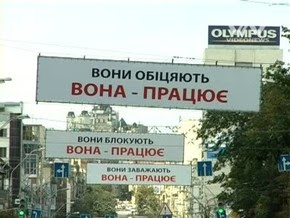


To my impression, the most active in the pre-electoral advertising are the Prime Minister of Ukraine Yulia Tymoshenko and ex-Chairman of Parliament Arseniy Yatseniuk. Their PR-ideas are rather original as well. Though, it seems to me that Mr. Yatseniuk is simply wasting money: his strangely colored boards and bizarre slogans are kind of shot in the eye for his ratings, imho.
So, Yulia Tymoshenko plays with contraposition. 'They promise, she works', 'They block, she works', 'They obstruct, she works', 'They ruin, she works', etc, her billboards are declaring. No names, but everyone understands, who is She.

So, Yulia Tymoshenko plays with contraposition. 'They promise, she works', 'They block, she works', 'They obstruct, she works', 'They ruin, she works', etc, her billboards are declaring. No names, but everyone understands, who is She.


The visual messages of Arseniy Yatsenyuk are supposed to use a kind of military symbolism to emphasize his willingness and ability to become a strong leader. But, frankly speaking, it doesn't look very convincing.


Wednesday, April 22, 2009
The President of Ukraine Viktor Yushchenko: “I'm ready to hold early presidential election”.
A couple of quotations from today’s press-conference of the President of Ukraine Viktor Yushchenko:
"The ruling coalition in Parliament is de facto absent".
"The majority voting system will never be presented again in Ukraine".
"The parliamentary coalition should prove it has 226 MPs, and re-introduce a candidature of PM".
"I'm ready to hold early presidential election, if the parliament agrees to hold early parliamentary election on a base of a new electoral law, and to abolish unlimited parliamentary immunities"
"Decision of the Constitutional Court shall be the base for future actions (concerning early parliamentary election. – T.V.)"
Meanwhile, the International Monetary Fund (IMF) made public its World Economic Outlook today. The Fund revised its forecast of GDP of Ukraine to a drop of 8 percent this year, from the earlier figure of 3 percent. It also predicted the economy of Ukraine would grow 1.0 percent in 2010.
The World Bank also revised its 2009 forecast this month, and said that the Ukrainian GDP will drop to 9 percent from a previous prediction of minus 4 percent.
Ukrainian government still thinks that GDP-2009 will grow on 0.4 percent. In 2008, the economy grew 2.1 percent.
"The ruling coalition in Parliament is de facto absent".
"The majority voting system will never be presented again in Ukraine".
"The parliamentary coalition should prove it has 226 MPs, and re-introduce a candidature of PM".
"I'm ready to hold early presidential election, if the parliament agrees to hold early parliamentary election on a base of a new electoral law, and to abolish unlimited parliamentary immunities"
"Decision of the Constitutional Court shall be the base for future actions (concerning early parliamentary election. – T.V.)"
Meanwhile, the International Monetary Fund (IMF) made public its World Economic Outlook today. The Fund revised its forecast of GDP of Ukraine to a drop of 8 percent this year, from the earlier figure of 3 percent. It also predicted the economy of Ukraine would grow 1.0 percent in 2010.
The World Bank also revised its 2009 forecast this month, and said that the Ukrainian GDP will drop to 9 percent from a previous prediction of minus 4 percent.
Ukrainian government still thinks that GDP-2009 will grow on 0.4 percent. In 2008, the economy grew 2.1 percent.
Tuesday, March 31, 2009
“After this speech, I’ll pass to Speaker Lytvyn my project of a new Constitution ”. Viktor Yushchenko addressed the Parliament of Ukraine.
The President of Ukraine Viktor Yushchenko has addressed the Parliament today with his annual speech. Mr. Yushchenko failed to appear in Verkhovna Rada with his speech last year - the parliamentary tribune was blocked - but this time he has fully made up for lost opportunity.
The ordinary presidential speech with the expected call for all the political leaders to stop fighting and unite all the forces for saving Ukrainian economy in crisis times was finished with a surprise. President informed that he's going to introduce to Parliament of Ukraine a new project of the Constitution of Ukraine - right now.
Viktor Yushchenko proposes a dramatic change of the very system of powers in Ukraine. First of all, he wants Ukraine to have the two-chamber Parliament, and to reduce a number of MPs.
According to President, the Lower Chamber of the Parliament of Ukraine shall be elected by proportional voting system (like today) with open political party lists. The Lower Chamber will form the Government and control its work. "The inability to form the Government will lead to the dismissal of the Lower Chamber, but not all the Parliament. In this case the work of the Parliament will not stop," Viktor Yushchenko noticed.
The Upper Chamber should be elected among the representatives of regions of the country - using the majority voting system. It will work in lose connection with the President of Ukraine, in particular, dealing with the security issues. Every district of Ukraine will have 3 Senators elected.
"The political turbulence will be left in the Lower Chamber of Parliament", Viktor Yushchenko thinks. "President, together with the Upper Chamber, will secure stability of the state".
The President of Ukraine called for an urgent examination of his project of the Constitution of Ukraine in Parliament.
The ordinary presidential speech with the expected call for all the political leaders to stop fighting and unite all the forces for saving Ukrainian economy in crisis times was finished with a surprise. President informed that he's going to introduce to Parliament of Ukraine a new project of the Constitution of Ukraine - right now.
Viktor Yushchenko proposes a dramatic change of the very system of powers in Ukraine. First of all, he wants Ukraine to have the two-chamber Parliament, and to reduce a number of MPs.
According to President, the Lower Chamber of the Parliament of Ukraine shall be elected by proportional voting system (like today) with open political party lists. The Lower Chamber will form the Government and control its work. "The inability to form the Government will lead to the dismissal of the Lower Chamber, but not all the Parliament. In this case the work of the Parliament will not stop," Viktor Yushchenko noticed.
The Upper Chamber should be elected among the representatives of regions of the country - using the majority voting system. It will work in lose connection with the President of Ukraine, in particular, dealing with the security issues. Every district of Ukraine will have 3 Senators elected.
"The political turbulence will be left in the Lower Chamber of Parliament", Viktor Yushchenko thinks. "President, together with the Upper Chamber, will secure stability of the state".
The President of Ukraine called for an urgent examination of his project of the Constitution of Ukraine in Parliament.
Thursday, March 19, 2009
Open Lists. Ukraine has learned how to hold free and fair elections, but it’s not enough to be called a true democracy.
In this post I would like to turn back to the question of the reform of electoral law in Ukraine. There are a lot of talks about how to change the way Ukrainians are electing the Parliament (I’ll stay away from the analysis of re-distribution of powers) or local Councils, but the very idea of reform is completely distorted. Instead of having a serious talk about the very details of a new electoral system that will fit to Ukrainian realities in a best way, most politicians are trying to switch the public attention to active, but non-effective discussions around one point – a need to move from the closed-party-lists to open-party-lists scheme, in frames of the current proportional voting system. I think it’s not enough at all.
Since the Orange revolution of 2004, all the elections in Ukraine were recognized as free and fair. But as a result of these free and fair elections, we, Ukrainians are receiving – again and again – the Parliament full of come-and-go people. The majority of Members of Parliament of Ukraine doesn’t make any serious decisions, but only thoughtlessly presses the “yes” or “no” buttons, in accordance with order of faction leaders. It has to be changed.
According to the current electoral law, Ukraine elects its Parliament on a base of proportional representation system with closed party lists. The system stipulates that Ukrainian citizens vote not for individuals, but for parties, which are receiving seats in Parliament proportionally to the amount of votes they had won. Every party draws up a list of its candidates for the seats in Parliament, but it must make public only the names of five first persons from the list. A couple of hundreds of other candidates may be hidden until the end of the vote – it’s a provision of the closed-party-lists type of proportional voting system.
As a result, according to the closed-party lists scheme, Ukrainians are voting not for all members of Parliament, but are only choosing between “groups of five”. Even if a party makes public the entire list, the electoral campaign has been centred on a little group of party leaders. And after the elections Ukrainian voters may realise that the party they voted for has in its list, for example, a personal massager of the party chief, or the secretary of a party sponsor. A very big problem of the current electoral system is also the fact that the Members of Parliament has almost no officially established connection with the regions of a country. People simply don’t feel they have a real representative in Parliament: there is no one to be called “my MP”.
It is naive to think that the problem will be cured, if all the party lists were open in its literal meaning – becoming public before the elections. Ukrainian parties are mostly based not on the ideology, but on their leaders who are associated with all the party. And the majority of Ukrainians will keep voting for the personalities they like, not taking care about any lists. (And even if an old woman from the village has an opportunity to read all the lists of all the parties, she will surely not be able to analyse them properly, and to estimate how much people from the list she may see in Parliament after the elections. To make the outcome of the parliamentary election more democratic, there is a need to change the voting system as a whole.
As to my point of view, the best thing for Ukraine is to come back to the majoritarian (plurality) system of vote: the person, not a party should win support of voters, and should represent Ukrainian people in Parliament. Ukraine still doesn’t have a developed party system. Imagine, only about 3% of the citizens of Ukraine are members of any party. That means that 97% of Ukrainians doesn’t feel close to any political party at all. Proportional system was established, among other issues, in order to build up the party system in Ukraine. This idea failed: new-formed Ukrainian democratic political parties in reality are something between the oligarchic lobby groups and fan clubs of charismatic leaders.
In frames of the current proportional, party-based system of vote, the easiest way for Ukraine would be to switch to one of the models of open party lists, when a voter receives a right not only to vote for a party, but also to express his or her preference for a particular candidate(s) in frames of the party list. That means that voter indicates not only a name of the party he or she favours, but also names the favourite candidates from this party, or even indicates the order of preference. Such a model is widely used in the countries of Western and Central Europe. I would propose also to move forward from a single constituency scheme Ukraine currently has. In this case the parties will have to draw up several regional lists of candidates, giving a chance for regional leaders to be elected, and also establishing a stronger link between regions and Parliament.
There are other things which I think have to be done to make the parliamentary election in Ukraine closer to the best democratic standards:
1. To adopt an Electoral Code, a single document, which would incorporate all the rules (including technical) concerning holding parliamentary, presidential and local elections.
2. To form the Registry of voters (at long last) to avoid fraud.
3. To change the provisions of electoral law, re-establishing the so-called “absence certificates” for people who are not at home at a day of election (for ex., they are in the other region of Ukraine or abroad) to have a possibility to realize their Constitutional right to vote.
Since the Orange revolution of 2004, all the elections in Ukraine were recognized as free and fair. But as a result of these free and fair elections, we, Ukrainians are receiving – again and again – the Parliament full of come-and-go people. The majority of Members of Parliament of Ukraine doesn’t make any serious decisions, but only thoughtlessly presses the “yes” or “no” buttons, in accordance with order of faction leaders. It has to be changed.
According to the current electoral law, Ukraine elects its Parliament on a base of proportional representation system with closed party lists. The system stipulates that Ukrainian citizens vote not for individuals, but for parties, which are receiving seats in Parliament proportionally to the amount of votes they had won. Every party draws up a list of its candidates for the seats in Parliament, but it must make public only the names of five first persons from the list. A couple of hundreds of other candidates may be hidden until the end of the vote – it’s a provision of the closed-party-lists type of proportional voting system.
As a result, according to the closed-party lists scheme, Ukrainians are voting not for all members of Parliament, but are only choosing between “groups of five”. Even if a party makes public the entire list, the electoral campaign has been centred on a little group of party leaders. And after the elections Ukrainian voters may realise that the party they voted for has in its list, for example, a personal massager of the party chief, or the secretary of a party sponsor. A very big problem of the current electoral system is also the fact that the Members of Parliament has almost no officially established connection with the regions of a country. People simply don’t feel they have a real representative in Parliament: there is no one to be called “my MP”.
It is naive to think that the problem will be cured, if all the party lists were open in its literal meaning – becoming public before the elections. Ukrainian parties are mostly based not on the ideology, but on their leaders who are associated with all the party. And the majority of Ukrainians will keep voting for the personalities they like, not taking care about any lists. (And even if an old woman from the village has an opportunity to read all the lists of all the parties, she will surely not be able to analyse them properly, and to estimate how much people from the list she may see in Parliament after the elections. To make the outcome of the parliamentary election more democratic, there is a need to change the voting system as a whole.
As to my point of view, the best thing for Ukraine is to come back to the majoritarian (plurality) system of vote: the person, not a party should win support of voters, and should represent Ukrainian people in Parliament. Ukraine still doesn’t have a developed party system. Imagine, only about 3% of the citizens of Ukraine are members of any party. That means that 97% of Ukrainians doesn’t feel close to any political party at all. Proportional system was established, among other issues, in order to build up the party system in Ukraine. This idea failed: new-formed Ukrainian democratic political parties in reality are something between the oligarchic lobby groups and fan clubs of charismatic leaders.
In frames of the current proportional, party-based system of vote, the easiest way for Ukraine would be to switch to one of the models of open party lists, when a voter receives a right not only to vote for a party, but also to express his or her preference for a particular candidate(s) in frames of the party list. That means that voter indicates not only a name of the party he or she favours, but also names the favourite candidates from this party, or even indicates the order of preference. Such a model is widely used in the countries of Western and Central Europe. I would propose also to move forward from a single constituency scheme Ukraine currently has. In this case the parties will have to draw up several regional lists of candidates, giving a chance for regional leaders to be elected, and also establishing a stronger link between regions and Parliament.
There are other things which I think have to be done to make the parliamentary election in Ukraine closer to the best democratic standards:
1. To adopt an Electoral Code, a single document, which would incorporate all the rules (including technical) concerning holding parliamentary, presidential and local elections.
2. To form the Registry of voters (at long last) to avoid fraud.
3. To change the provisions of electoral law, re-establishing the so-called “absence certificates” for people who are not at home at a day of election (for ex., they are in the other region of Ukraine or abroad) to have a possibility to realize their Constitutional right to vote.
Sunday, March 15, 2009
Open Vote. Ukrainian authorities want to change the electoral law: to use it at the early parliamentary poll, combined with the presidential election.
Viktor Baloha, a Head of the Secretariat of the President of Ukraine, informed on Wednesday, 11 March that the Secretariat’s legal services are drafting proposals to change the electoral legislation in country. The objects of change are parliamentary and local elections. In particular, the Secretariat is going to propose to switch to the open party lists (in frames of proportional system). The relevant projects of law will be tabled in Parliament soon.
“Due to a current election system, we have the Parliament, which is considered by the majority of experts as the most unprofessional. Yesterday massage therapists, office-girls, guards, and drivers of party bonzes are working now as People’s Deputies (Members of Parliament. – T.V.). I am sure that they are exactly not the people Ukrainian voters wanted to delegate to power. Ukrainians want to know, whom they are electing”, Mr. Baloha emphasized.
One day before – on 11 March 2009 – the President of Ukraine Viktor Yushchenko released the Member of Parliament of Ukraine Sergiy Holovaty (the oppositional Party of Regions) from his duty as a Member of the European Commission for Democracy through Law (Venice Commission), the advisory body of the Council of Europe. Starting from this week, Maryna Stavniychuck, the Deputy Head of the Presidential Secretariat, is representing Ukraine at the sittings in the Scuola Grande di San Giovanni Evangelista in Venice.
The dismissal of Sergiy Holovaty, a lawyer, who is very respected in Europe, and in the Council of Europe in particular, was not a coincidence: the Venice Commission has examined two documents concerning elections in Ukraine on 14 March. Unfortunately, I still have no information about the decision of the experts of the Venice Commission on a Draft law of Ukraine amending the Constitution of Ukraine, initiated by Members of Parliament of Ukraine Viktor Yanukovych (Head of the Party of Regions) and Oleksandr Lavrynovych (Vice-Speaker of Parliament, member of the Party of Regions), and a Draft law amending the Law on Election of People’s Deputies of Ukraine, initiated by Oleksandr Lavrynovych and Andriy Portnov (Block of Yulia Tymoshenko). I know only that the Venice Commission is not over-enthusiastic about the ideas to cut off dramatically the presidential powers in Ukraine. Anyway it is clear that the current President wanted to have a bit of influence on this decision.
The amendments to the electoral law may be used earlier than expected. The Speaker of the Parliament of Ukraine Volodymyr Lytvyn mentioned on 12 March that after the presentation of a mew electoral system, the call for the simultaneous presidential, parliamentary and local elections is quite possible. A Member of Parliament from Our Ukraine – People’s Self-Defence block Vladyslav Kaskiv also thinks that the early parliamentary election may be held as “the most easy way out”. Viktor Yanukovych also said he’s in favour of the simultaneous parliamentary/presidential poll in his televised interview.
Another news of the expiring week is that the leader of the Communist Party Petro Symonenko said he has already prepared the motion for the impeachment of the President of Ukraine. “Serving President has not ever infracted the Constitution and laws of Ukraine”, answered the Head of the Presidential Secretariat in the newspaper interview. “It is easy to explain the words of a member of democratic coalition Petro Symonenko. He is so inspired by Tymoshenko’s instructions that voters may not understand, whether he is a member of her party or the Head of the Communists”. According to Mr. Baloha, the presidential election will be held on 17 January, 2010. The Head of the Secretariat did not inform journalists, whether President is going to take part in the election.
Meanwhile, we had a very interesting public event here in Kyiv on Friday: around 350 people gathered near the building of Parliament, demanding to introduce the direct presidential rule in the country. “Crisis is a right time for the presidential rule”, their slogans said.
“Due to a current election system, we have the Parliament, which is considered by the majority of experts as the most unprofessional. Yesterday massage therapists, office-girls, guards, and drivers of party bonzes are working now as People’s Deputies (Members of Parliament. – T.V.). I am sure that they are exactly not the people Ukrainian voters wanted to delegate to power. Ukrainians want to know, whom they are electing”, Mr. Baloha emphasized.
One day before – on 11 March 2009 – the President of Ukraine Viktor Yushchenko released the Member of Parliament of Ukraine Sergiy Holovaty (the oppositional Party of Regions) from his duty as a Member of the European Commission for Democracy through Law (Venice Commission), the advisory body of the Council of Europe. Starting from this week, Maryna Stavniychuck, the Deputy Head of the Presidential Secretariat, is representing Ukraine at the sittings in the Scuola Grande di San Giovanni Evangelista in Venice.
The dismissal of Sergiy Holovaty, a lawyer, who is very respected in Europe, and in the Council of Europe in particular, was not a coincidence: the Venice Commission has examined two documents concerning elections in Ukraine on 14 March. Unfortunately, I still have no information about the decision of the experts of the Venice Commission on a Draft law of Ukraine amending the Constitution of Ukraine, initiated by Members of Parliament of Ukraine Viktor Yanukovych (Head of the Party of Regions) and Oleksandr Lavrynovych (Vice-Speaker of Parliament, member of the Party of Regions), and a Draft law amending the Law on Election of People’s Deputies of Ukraine, initiated by Oleksandr Lavrynovych and Andriy Portnov (Block of Yulia Tymoshenko). I know only that the Venice Commission is not over-enthusiastic about the ideas to cut off dramatically the presidential powers in Ukraine. Anyway it is clear that the current President wanted to have a bit of influence on this decision.
The amendments to the electoral law may be used earlier than expected. The Speaker of the Parliament of Ukraine Volodymyr Lytvyn mentioned on 12 March that after the presentation of a mew electoral system, the call for the simultaneous presidential, parliamentary and local elections is quite possible. A Member of Parliament from Our Ukraine – People’s Self-Defence block Vladyslav Kaskiv also thinks that the early parliamentary election may be held as “the most easy way out”. Viktor Yanukovych also said he’s in favour of the simultaneous parliamentary/presidential poll in his televised interview.
Another news of the expiring week is that the leader of the Communist Party Petro Symonenko said he has already prepared the motion for the impeachment of the President of Ukraine. “Serving President has not ever infracted the Constitution and laws of Ukraine”, answered the Head of the Presidential Secretariat in the newspaper interview. “It is easy to explain the words of a member of democratic coalition Petro Symonenko. He is so inspired by Tymoshenko’s instructions that voters may not understand, whether he is a member of her party or the Head of the Communists”. According to Mr. Baloha, the presidential election will be held on 17 January, 2010. The Head of the Secretariat did not inform journalists, whether President is going to take part in the election.
Meanwhile, we had a very interesting public event here in Kyiv on Friday: around 350 people gathered near the building of Parliament, demanding to introduce the direct presidential rule in the country. “Crisis is a right time for the presidential rule”, their slogans said.
Saturday, January 24, 2009
Next regular election of the President of Ukraine will be held in October 2009. Or in January 2010. Or in December 2010.
The Prime Minister of Ukraine Yulia Tymoshenko made a very interesting statement yesterday. She said, “it left 9 month until the election of President” in Ukraine. It was not a kind of “slip of the tongue”: Mrs. Tymoshenko repeated the phrase about the nine months a couple of times. So, she will try to schedule the regular Presidential election for late October 2009.
The Head of the Committee on Judicial Policy of the Verkhovna Rada of Ukraine Sergiy Mishchenko said on Friday, 23 January that he has the information from the insiders in Presidential Secretariat that they are trying to agree with the Central Election Commission to hold the presidential vote in December 2010. Besides, Mr. Mishchenko himself is sure that the Presidential election should be held on 17 January 2010, counting this date from the Inauguration day of 23 January 2005.
According to Ukrainian law, the date of the regular election of President has to be scheduled by the resolution of Parliament.
A bit of history:
The Head of the Committee on Judicial Policy of the Verkhovna Rada of Ukraine Sergiy Mishchenko said on Friday, 23 January that he has the information from the insiders in Presidential Secretariat that they are trying to agree with the Central Election Commission to hold the presidential vote in December 2010. Besides, Mr. Mishchenko himself is sure that the Presidential election should be held on 17 January 2010, counting this date from the Inauguration day of 23 January 2005.
According to Ukrainian law, the date of the regular election of President has to be scheduled by the resolution of Parliament.
A bit of history:
The first President of Ukraine – Leonid Kravchuk – was elected in one tour on 1 December 2001.
In 1994 the early presidential election was held together with early parliamentary election: first tour took place on 26 June 1994, and the second tour – on 10 July 1994. Leonid Kuchma was a winner of presidential race, Leonid Kravchuk lost.The third presidential election in Ukraine was held in 1999: first tour was on 31 October 1999 and second tour – on 14 November 1999. The leader of the Communist party Petro Symonenko couldn’t beat President Kuchma, and he saved his post with more than 56% of voters’ support.
The first tour of presidential election 2004 was held on 31 October. Current President Viktor Yushchenko and current opposition leader Viktor Yanukovych met in a second tour on 21 November. The Central Election Commission declared the winner was Viktor Yanukovych. After the mass actions of protest, later called the Orange revolution, the Supreme Court of Ukraine cancelled the results of the 2nd tour on 3 December. The new second tour was held on 26 December. Viktor Yushchenko won with the result of 51.99%.
Thursday, January 22, 2009
The Time Bomb. According to the new Russian gas price formula, with the recovery of a world economy, the economy of Ukraine will feel worse.
In the comment to my last post, Leopolis mentioned (very reasonably) that the reliance on a cheap gas has harmed Ukraine’s energy security. It harmed Ukrainian economy as well. Yes, that’s true that Ukraine lost a lot of time, not taking any significant measure to ensure the development of energy saving programmes. As a result, Ukrainian industry is extremely energy consuming, and Ukrainian economy is one of the most energy intensive on the continent. But it is not a fault of Viktor Yushchenko as a President (though he could do something in this field instead of just talking). The problem is that Ukrainian and foreign (mostly Russian) oligarchs who privatised big powerful plants and factories – at a very low price actually – didn’t care at all about any energy saving during all the 17 years of independence of Ukraine. These people, together with Ukrainian politicians, just used low gas prices to earn millions, or even billions of dollars. Business climate is so co-dependent with political situation in Ukraine that it’s really more reasonable for businessmen to have a fast profit today than to invest in an uncertain future.
Anyway, to switch to the market gas prices at the peak of the world economy crisis is also an evil for the country. Ukrainian industry simply doesn’t have time and financial strength for quick modernization and re-equipment. As a result, thousands of workers will lose jobs, provoking the social crisis. It opens a room for some radical or extremist ideas to override the common sense, which is really dangerous.
But the main problem with Russia-Ukraine gas agreement is that it contains a delayed-action bomb – according to the gas price formula, with the recovery of a world economy, Ukrainian economy will feel worse. Everyone noticed that the base gas price for that formula (which nobody have seen) is $450 per tcm. So, de facto Ukraine agreed for the raise of the price of Russian gas almost in three times – in December 2008 Kiev still paid $179.5 per tcm of gas from Russian pipeline.
$450 is really a very high level, taking to the account the geographical closeness of Ukraine to Russia. For example, in the first quarter-2009 Germany will pay $470/tcm, but the cost of transit of gas from Russia-Ukraine border to Germany costs not less than $50/tcm (only Ukrainian transit fee is around $20/tcm). One more example: according to the information of the Secretariat of the President of Ukraine, Hungary will pay for Russian gas only $400/tcm in the first quarter-2009. Romania pays $470, but buys only around 4 bcm of gas every year.
So, if we take these “European averages” together, we will have a base price for Ukraine around $400-420, but not $450.
Ukraine will not suffer a lot from the new gas price in 2009, as it will be presented with 20% discount. Meanwhile, it is still not clear, how much will Kiev pay in average during the year. Gazprom officials made public only the price for the first quarter 2009 – $360/tcm, and mentioned that the average price “may be less than $250”. The Prime Minister of Ukraine Yulia Tymoshenko said that the average figure is $228.8. It’s still $50 more than a price-2008, but Ukraine will definitely survive.
Well, Ukrainian industry will survive in 2009, but not develop. European industry instead will have a unique opportunity to use low gas prices for future growth of its potential. Ukrainian plants and factories will definitely lose their market competitiveness. I have to mention here that – according to the Moscow agreements – the GazpromSbytUkraine Company will control up to 25% of the domestic industry gas market of Ukraine, so, Russians will have a possibility to support loyal and “punish” competitive Ukrainian enterprises.
But the most important changes are expected not in short-term, but in mid-term prospects. What will happen, when the world economy will start recovering from the current crisis? Oil price will grow. As oil price will grow, gas for Ukraine will be more and more expensive. I would like to inform that the gas price of $450 corresponds not with a peak oil price of 2008 - $140/barrel – but with the price of Brent at the level of $111,4, according to the Naftogaz source. So, in 1,5-2 years time Ukraine will unfortunately face its own big economy crisis. …But it’s not an important question for Ukrainian politicians: all the worst is going to happen AFTER the presidential election.
Anyway, to switch to the market gas prices at the peak of the world economy crisis is also an evil for the country. Ukrainian industry simply doesn’t have time and financial strength for quick modernization and re-equipment. As a result, thousands of workers will lose jobs, provoking the social crisis. It opens a room for some radical or extremist ideas to override the common sense, which is really dangerous.
But the main problem with Russia-Ukraine gas agreement is that it contains a delayed-action bomb – according to the gas price formula, with the recovery of a world economy, Ukrainian economy will feel worse. Everyone noticed that the base gas price for that formula (which nobody have seen) is $450 per tcm. So, de facto Ukraine agreed for the raise of the price of Russian gas almost in three times – in December 2008 Kiev still paid $179.5 per tcm of gas from Russian pipeline.
$450 is really a very high level, taking to the account the geographical closeness of Ukraine to Russia. For example, in the first quarter-2009 Germany will pay $470/tcm, but the cost of transit of gas from Russia-Ukraine border to Germany costs not less than $50/tcm (only Ukrainian transit fee is around $20/tcm). One more example: according to the information of the Secretariat of the President of Ukraine, Hungary will pay for Russian gas only $400/tcm in the first quarter-2009. Romania pays $470, but buys only around 4 bcm of gas every year.
So, if we take these “European averages” together, we will have a base price for Ukraine around $400-420, but not $450.
Ukraine will not suffer a lot from the new gas price in 2009, as it will be presented with 20% discount. Meanwhile, it is still not clear, how much will Kiev pay in average during the year. Gazprom officials made public only the price for the first quarter 2009 – $360/tcm, and mentioned that the average price “may be less than $250”. The Prime Minister of Ukraine Yulia Tymoshenko said that the average figure is $228.8. It’s still $50 more than a price-2008, but Ukraine will definitely survive.
Well, Ukrainian industry will survive in 2009, but not develop. European industry instead will have a unique opportunity to use low gas prices for future growth of its potential. Ukrainian plants and factories will definitely lose their market competitiveness. I have to mention here that – according to the Moscow agreements – the GazpromSbytUkraine Company will control up to 25% of the domestic industry gas market of Ukraine, so, Russians will have a possibility to support loyal and “punish” competitive Ukrainian enterprises.
But the most important changes are expected not in short-term, but in mid-term prospects. What will happen, when the world economy will start recovering from the current crisis? Oil price will grow. As oil price will grow, gas for Ukraine will be more and more expensive. I would like to inform that the gas price of $450 corresponds not with a peak oil price of 2008 - $140/barrel – but with the price of Brent at the level of $111,4, according to the Naftogaz source. So, in 1,5-2 years time Ukraine will unfortunately face its own big economy crisis. …But it’s not an important question for Ukrainian politicians: all the worst is going to happen AFTER the presidential election.
Subscribe to:
Posts (Atom)


 Posts
Posts


