172 MPs from the Party of Regions faction (whole faction)
7 MPs from Yulia Tymoshenko Block
15 MPs from Our Ukraine – People’s Self-Defense faction
27 MPs from Communist party faction (whole faction)
19 MPs from Block of Volodymyr Lytvyn (all except Lytvyn)
3 independent MPs
Showing posts with label Parliament. Show all posts
Showing posts with label Parliament. Show all posts
Wednesday, March 3, 2010
The Parliament of Ukraine has just passed a no-confidence motion against the Government of Yulia Tymoshenko.
Here are the results of the vote. 243 Members of Parliament of 404 registered today has voted in favor of Yulia Tymoshenko’s dismissal. Among them were:


Thursday, February 25, 2010
Yushchenko or Yatseniuk – who will be the next Prime Minister of Ukraine?
Viktor Yanukovych was inaugurated as the President of Ukraine today. Yulia Tymoshenko still insists that he is not her President. Prime Minister and members of her faction have even ignored the official inauguration events. Looks not very smart, imho.
But who will be the next Prime Minister? Has Yulia Tymoshenko any chance to save her chair? Here is some news on the negotiations inside Parliament:
1. The Block of Yulia Tymoshenko (BYT) has started to gather signatures of MPs to justify the current parliamentary coalition, the existence of which is rather questionable. (The Speaker of Ukrainian Parliament Volodymyr Lytvyn has demanded to prove the existence of current coalition before 2 of March, otherwise a new coalition shall be formed, or in 60 days Parliament will be dismissed according to the Constitution).
2. The BYT will definitely fail to gather 226 signatures; it is obviously seen after today’s sitting of the Our Ukraine – People’s Self-Defense (OU-PS) faction. Not more than 10 MPs from the faction would support Mrs. Tymoshenko premiership.
3. To form a new coalition (in order to avoid the early election) the Party of Regions and its leader Viktor Yanukovych need support of the OU-PS faction.
4. According to the info from today’s OU-PS faction sitting, the majority of MPs may support the coalition with Yanukovych party, but only if the ‘democratic Prime Minister’ is elected (i.e. not-member of the Party of Regions).
5. The candidacy of ex-President Viktor Yushchenko has been actively lobbied, and is in general approved by the Party of Regions. But the OU-PS faction (ex-pro-Yushchenko monolith, now split to little groups of interest) has not approved the Yushchenko-PM-scheme. Yet?
6. Today OU-PS MPs had discussed the idea to nominate ‘number 4’ in the first round of Presidential election Arseniy Yatseniuk as a future PM. He made a speech, which did not inspire the majority of veteran MPs as was made in Yatseniuk’s habitual paternalistic and moralizing style.
7. On Monday, 1st of March, the OU-PS faction will have the next sitting to approve the final decision. Before that they are going to negotiate with Yanukovych, and also with Tymoshenko.
8. It sounds surreal, but I think Viktor Yushchenko has about 80% of chance to become next Prime Minister – he is the most convenient for all (as nobody wants to keep the rating of Yatseniuk).
9. Though the PM’s chair is not a convenient place to seat in these days, due to the total crisis of Ukrainian economy and state finances, when the declaration of default is a very realistic outcome.
But who will be the next Prime Minister? Has Yulia Tymoshenko any chance to save her chair? Here is some news on the negotiations inside Parliament:
1. The Block of Yulia Tymoshenko (BYT) has started to gather signatures of MPs to justify the current parliamentary coalition, the existence of which is rather questionable. (The Speaker of Ukrainian Parliament Volodymyr Lytvyn has demanded to prove the existence of current coalition before 2 of March, otherwise a new coalition shall be formed, or in 60 days Parliament will be dismissed according to the Constitution).
2. The BYT will definitely fail to gather 226 signatures; it is obviously seen after today’s sitting of the Our Ukraine – People’s Self-Defense (OU-PS) faction. Not more than 10 MPs from the faction would support Mrs. Tymoshenko premiership.
3. To form a new coalition (in order to avoid the early election) the Party of Regions and its leader Viktor Yanukovych need support of the OU-PS faction.
4. According to the info from today’s OU-PS faction sitting, the majority of MPs may support the coalition with Yanukovych party, but only if the ‘democratic Prime Minister’ is elected (i.e. not-member of the Party of Regions).
5. The candidacy of ex-President Viktor Yushchenko has been actively lobbied, and is in general approved by the Party of Regions. But the OU-PS faction (ex-pro-Yushchenko monolith, now split to little groups of interest) has not approved the Yushchenko-PM-scheme. Yet?
6. Today OU-PS MPs had discussed the idea to nominate ‘number 4’ in the first round of Presidential election Arseniy Yatseniuk as a future PM. He made a speech, which did not inspire the majority of veteran MPs as was made in Yatseniuk’s habitual paternalistic and moralizing style.
7. On Monday, 1st of March, the OU-PS faction will have the next sitting to approve the final decision. Before that they are going to negotiate with Yanukovych, and also with Tymoshenko.
8. It sounds surreal, but I think Viktor Yushchenko has about 80% of chance to become next Prime Minister – he is the most convenient for all (as nobody wants to keep the rating of Yatseniuk).
9. Though the PM’s chair is not a convenient place to seat in these days, due to the total crisis of Ukrainian economy and state finances, when the declaration of default is a very realistic outcome.
Monday, October 26, 2009
The Endless Circle. Ukraine may have snap parliamentary poll in May 2010.
Ukraine may expect the comeback of a ghost of an early parliamentary election in 2010. This secret is widely known as after the presidential election in January-February 2010, the winner (whoever it will be) would surely want to take it all, and to form the majority in Parliament using the effect of his recent victory.
The same point of view has confirmed Volodymyr Lytvyn, Chairman of the Parliament of Ukraine and a newly registered presidential candidate. In May 2010 Ukraine will have snap parliamentary election, he told journalists today.
He emphasized that ‘under the current circumstances in Parliament, a lot of problems will appear’, that’s why the new President will surely try to nail down a success. The key position in country will be the Prime Minister’s office, Mr. Lytvyn added.
The same point of view has confirmed Volodymyr Lytvyn, Chairman of the Parliament of Ukraine and a newly registered presidential candidate. In May 2010 Ukraine will have snap parliamentary election, he told journalists today.
He emphasized that ‘under the current circumstances in Parliament, a lot of problems will appear’, that’s why the new President will surely try to nail down a success. The key position in country will be the Prime Minister’s office, Mr. Lytvyn added.
Thursday, October 22, 2009
Wednesday, October 21, 2009
First-comers. The Central Election Commission of Ukraine received registration papers from first two presidential candidates.
On 20 of October the Central Election Commission of Ukraine started to accept registration documents from potential candidates to the presidential post. The first guy who submitted his papers to the Central Election Commission was some Oleh Riabokon, 36 y. o. lawyer. Mr. Riabokon is a co-founder of the “Master and Partners” law firm. Among other co-founders of this company was Sergiy Vlasenko (Member of Parliament, Yulia Tymoshenko block). Of course, Mr. Ryabokon has no chance to win any noticeable result during this election, except the PR for his name and his company.
The second fastest pretender for the first chair in the country is Anatoly Hrytsenko, MP from the “Our Ukraine – People’s Self-Defence” faction, ex-Minister of Defense, and ex-team-mate of the President of Ukraine Viktor Yushchenko. The friendship with President finished after the dismissal of Mr. Hrytsenko from the ministerial office. Anatoly Hrytsenko also has no chance to become a next President of Ukraine, but his rating may rise up to the level of 5-6 heavyweighters, which will surely help him during the next parliamentary election (still expected next year). To whom it may be interesting, I am giving a link to the Ukrainian language website of Mr. Hrytsenko.
The second fastest pretender for the first chair in the country is Anatoly Hrytsenko, MP from the “Our Ukraine – People’s Self-Defence” faction, ex-Minister of Defense, and ex-team-mate of the President of Ukraine Viktor Yushchenko. The friendship with President finished after the dismissal of Mr. Hrytsenko from the ministerial office. Anatoly Hrytsenko also has no chance to become a next President of Ukraine, but his rating may rise up to the level of 5-6 heavyweighters, which will surely help him during the next parliamentary election (still expected next year). To whom it may be interesting, I am giving a link to the Ukrainian language website of Mr. Hrytsenko.
Tuesday, September 8, 2009
Time management. The highweighters of Ukrainian politics have opened presidential race long time before its official start.
There is no such a thing as “a lack of time” for a person who understands, what the time-management is. That’s why I’ve decided to come back to blogging, despite of a pretty much pressed working schedule. Ukrainian politicians don’t want to waist the time left before the official start of the presidential race also (according to the 'new edition' of the Law on elections, it's 19 October 2009): streets of the cities, towns and villages of Ukraine, as well as the sides of big roads, are already stuffed with the billboards with political promises.
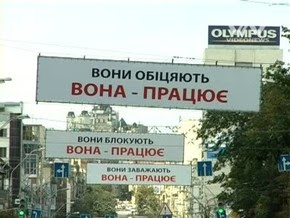


To my impression, the most active in the pre-electoral advertising are the Prime Minister of Ukraine Yulia Tymoshenko and ex-Chairman of Parliament Arseniy Yatseniuk. Their PR-ideas are rather original as well. Though, it seems to me that Mr. Yatseniuk is simply wasting money: his strangely colored boards and bizarre slogans are kind of shot in the eye for his ratings, imho.
So, Yulia Tymoshenko plays with contraposition. 'They promise, she works', 'They block, she works', 'They obstruct, she works', 'They ruin, she works', etc, her billboards are declaring. No names, but everyone understands, who is She.

So, Yulia Tymoshenko plays with contraposition. 'They promise, she works', 'They block, she works', 'They obstruct, she works', 'They ruin, she works', etc, her billboards are declaring. No names, but everyone understands, who is She.


The visual messages of Arseniy Yatsenyuk are supposed to use a kind of military symbolism to emphasize his willingness and ability to become a strong leader. But, frankly speaking, it doesn't look very convincing.


Tuesday, March 31, 2009
“After this speech, I’ll pass to Speaker Lytvyn my project of a new Constitution ”. Viktor Yushchenko addressed the Parliament of Ukraine.
The President of Ukraine Viktor Yushchenko has addressed the Parliament today with his annual speech. Mr. Yushchenko failed to appear in Verkhovna Rada with his speech last year - the parliamentary tribune was blocked - but this time he has fully made up for lost opportunity.
The ordinary presidential speech with the expected call for all the political leaders to stop fighting and unite all the forces for saving Ukrainian economy in crisis times was finished with a surprise. President informed that he's going to introduce to Parliament of Ukraine a new project of the Constitution of Ukraine - right now.
Viktor Yushchenko proposes a dramatic change of the very system of powers in Ukraine. First of all, he wants Ukraine to have the two-chamber Parliament, and to reduce a number of MPs.
According to President, the Lower Chamber of the Parliament of Ukraine shall be elected by proportional voting system (like today) with open political party lists. The Lower Chamber will form the Government and control its work. "The inability to form the Government will lead to the dismissal of the Lower Chamber, but not all the Parliament. In this case the work of the Parliament will not stop," Viktor Yushchenko noticed.
The Upper Chamber should be elected among the representatives of regions of the country - using the majority voting system. It will work in lose connection with the President of Ukraine, in particular, dealing with the security issues. Every district of Ukraine will have 3 Senators elected.
"The political turbulence will be left in the Lower Chamber of Parliament", Viktor Yushchenko thinks. "President, together with the Upper Chamber, will secure stability of the state".
The President of Ukraine called for an urgent examination of his project of the Constitution of Ukraine in Parliament.
The ordinary presidential speech with the expected call for all the political leaders to stop fighting and unite all the forces for saving Ukrainian economy in crisis times was finished with a surprise. President informed that he's going to introduce to Parliament of Ukraine a new project of the Constitution of Ukraine - right now.
Viktor Yushchenko proposes a dramatic change of the very system of powers in Ukraine. First of all, he wants Ukraine to have the two-chamber Parliament, and to reduce a number of MPs.
According to President, the Lower Chamber of the Parliament of Ukraine shall be elected by proportional voting system (like today) with open political party lists. The Lower Chamber will form the Government and control its work. "The inability to form the Government will lead to the dismissal of the Lower Chamber, but not all the Parliament. In this case the work of the Parliament will not stop," Viktor Yushchenko noticed.
The Upper Chamber should be elected among the representatives of regions of the country - using the majority voting system. It will work in lose connection with the President of Ukraine, in particular, dealing with the security issues. Every district of Ukraine will have 3 Senators elected.
"The political turbulence will be left in the Lower Chamber of Parliament", Viktor Yushchenko thinks. "President, together with the Upper Chamber, will secure stability of the state".
The President of Ukraine called for an urgent examination of his project of the Constitution of Ukraine in Parliament.
Thursday, March 19, 2009
Open Lists. Ukraine has learned how to hold free and fair elections, but it’s not enough to be called a true democracy.
In this post I would like to turn back to the question of the reform of electoral law in Ukraine. There are a lot of talks about how to change the way Ukrainians are electing the Parliament (I’ll stay away from the analysis of re-distribution of powers) or local Councils, but the very idea of reform is completely distorted. Instead of having a serious talk about the very details of a new electoral system that will fit to Ukrainian realities in a best way, most politicians are trying to switch the public attention to active, but non-effective discussions around one point – a need to move from the closed-party-lists to open-party-lists scheme, in frames of the current proportional voting system. I think it’s not enough at all.
Since the Orange revolution of 2004, all the elections in Ukraine were recognized as free and fair. But as a result of these free and fair elections, we, Ukrainians are receiving – again and again – the Parliament full of come-and-go people. The majority of Members of Parliament of Ukraine doesn’t make any serious decisions, but only thoughtlessly presses the “yes” or “no” buttons, in accordance with order of faction leaders. It has to be changed.
According to the current electoral law, Ukraine elects its Parliament on a base of proportional representation system with closed party lists. The system stipulates that Ukrainian citizens vote not for individuals, but for parties, which are receiving seats in Parliament proportionally to the amount of votes they had won. Every party draws up a list of its candidates for the seats in Parliament, but it must make public only the names of five first persons from the list. A couple of hundreds of other candidates may be hidden until the end of the vote – it’s a provision of the closed-party-lists type of proportional voting system.
As a result, according to the closed-party lists scheme, Ukrainians are voting not for all members of Parliament, but are only choosing between “groups of five”. Even if a party makes public the entire list, the electoral campaign has been centred on a little group of party leaders. And after the elections Ukrainian voters may realise that the party they voted for has in its list, for example, a personal massager of the party chief, or the secretary of a party sponsor. A very big problem of the current electoral system is also the fact that the Members of Parliament has almost no officially established connection with the regions of a country. People simply don’t feel they have a real representative in Parliament: there is no one to be called “my MP”.
It is naive to think that the problem will be cured, if all the party lists were open in its literal meaning – becoming public before the elections. Ukrainian parties are mostly based not on the ideology, but on their leaders who are associated with all the party. And the majority of Ukrainians will keep voting for the personalities they like, not taking care about any lists. (And even if an old woman from the village has an opportunity to read all the lists of all the parties, she will surely not be able to analyse them properly, and to estimate how much people from the list she may see in Parliament after the elections. To make the outcome of the parliamentary election more democratic, there is a need to change the voting system as a whole.
As to my point of view, the best thing for Ukraine is to come back to the majoritarian (plurality) system of vote: the person, not a party should win support of voters, and should represent Ukrainian people in Parliament. Ukraine still doesn’t have a developed party system. Imagine, only about 3% of the citizens of Ukraine are members of any party. That means that 97% of Ukrainians doesn’t feel close to any political party at all. Proportional system was established, among other issues, in order to build up the party system in Ukraine. This idea failed: new-formed Ukrainian democratic political parties in reality are something between the oligarchic lobby groups and fan clubs of charismatic leaders.
In frames of the current proportional, party-based system of vote, the easiest way for Ukraine would be to switch to one of the models of open party lists, when a voter receives a right not only to vote for a party, but also to express his or her preference for a particular candidate(s) in frames of the party list. That means that voter indicates not only a name of the party he or she favours, but also names the favourite candidates from this party, or even indicates the order of preference. Such a model is widely used in the countries of Western and Central Europe. I would propose also to move forward from a single constituency scheme Ukraine currently has. In this case the parties will have to draw up several regional lists of candidates, giving a chance for regional leaders to be elected, and also establishing a stronger link between regions and Parliament.
There are other things which I think have to be done to make the parliamentary election in Ukraine closer to the best democratic standards:
1. To adopt an Electoral Code, a single document, which would incorporate all the rules (including technical) concerning holding parliamentary, presidential and local elections.
2. To form the Registry of voters (at long last) to avoid fraud.
3. To change the provisions of electoral law, re-establishing the so-called “absence certificates” for people who are not at home at a day of election (for ex., they are in the other region of Ukraine or abroad) to have a possibility to realize their Constitutional right to vote.
Since the Orange revolution of 2004, all the elections in Ukraine were recognized as free and fair. But as a result of these free and fair elections, we, Ukrainians are receiving – again and again – the Parliament full of come-and-go people. The majority of Members of Parliament of Ukraine doesn’t make any serious decisions, but only thoughtlessly presses the “yes” or “no” buttons, in accordance with order of faction leaders. It has to be changed.
According to the current electoral law, Ukraine elects its Parliament on a base of proportional representation system with closed party lists. The system stipulates that Ukrainian citizens vote not for individuals, but for parties, which are receiving seats in Parliament proportionally to the amount of votes they had won. Every party draws up a list of its candidates for the seats in Parliament, but it must make public only the names of five first persons from the list. A couple of hundreds of other candidates may be hidden until the end of the vote – it’s a provision of the closed-party-lists type of proportional voting system.
As a result, according to the closed-party lists scheme, Ukrainians are voting not for all members of Parliament, but are only choosing between “groups of five”. Even if a party makes public the entire list, the electoral campaign has been centred on a little group of party leaders. And after the elections Ukrainian voters may realise that the party they voted for has in its list, for example, a personal massager of the party chief, or the secretary of a party sponsor. A very big problem of the current electoral system is also the fact that the Members of Parliament has almost no officially established connection with the regions of a country. People simply don’t feel they have a real representative in Parliament: there is no one to be called “my MP”.
It is naive to think that the problem will be cured, if all the party lists were open in its literal meaning – becoming public before the elections. Ukrainian parties are mostly based not on the ideology, but on their leaders who are associated with all the party. And the majority of Ukrainians will keep voting for the personalities they like, not taking care about any lists. (And even if an old woman from the village has an opportunity to read all the lists of all the parties, she will surely not be able to analyse them properly, and to estimate how much people from the list she may see in Parliament after the elections. To make the outcome of the parliamentary election more democratic, there is a need to change the voting system as a whole.
As to my point of view, the best thing for Ukraine is to come back to the majoritarian (plurality) system of vote: the person, not a party should win support of voters, and should represent Ukrainian people in Parliament. Ukraine still doesn’t have a developed party system. Imagine, only about 3% of the citizens of Ukraine are members of any party. That means that 97% of Ukrainians doesn’t feel close to any political party at all. Proportional system was established, among other issues, in order to build up the party system in Ukraine. This idea failed: new-formed Ukrainian democratic political parties in reality are something between the oligarchic lobby groups and fan clubs of charismatic leaders.
In frames of the current proportional, party-based system of vote, the easiest way for Ukraine would be to switch to one of the models of open party lists, when a voter receives a right not only to vote for a party, but also to express his or her preference for a particular candidate(s) in frames of the party list. That means that voter indicates not only a name of the party he or she favours, but also names the favourite candidates from this party, or even indicates the order of preference. Such a model is widely used in the countries of Western and Central Europe. I would propose also to move forward from a single constituency scheme Ukraine currently has. In this case the parties will have to draw up several regional lists of candidates, giving a chance for regional leaders to be elected, and also establishing a stronger link between regions and Parliament.
There are other things which I think have to be done to make the parliamentary election in Ukraine closer to the best democratic standards:
1. To adopt an Electoral Code, a single document, which would incorporate all the rules (including technical) concerning holding parliamentary, presidential and local elections.
2. To form the Registry of voters (at long last) to avoid fraud.
3. To change the provisions of electoral law, re-establishing the so-called “absence certificates” for people who are not at home at a day of election (for ex., they are in the other region of Ukraine or abroad) to have a possibility to realize their Constitutional right to vote.
Thursday, February 5, 2009
An old ghost is back. Ukrainian politicians re-started to talk about the early parliamentary election in April or May 2009.
The Prime Minister of Ukraine Yulia Tymoshenko has reported to the Parliament of Ukraine on the state of Ukrainian economy today. Now she’s answering the questions of the MPs. After that the project of law named “On the responsibility of the Cabinet of Ministers of Ukraine” may be put to vote. The author of the document, the leader of the opposition Party of Regions (PR) Viktor Yanukovych proposes to dismiss Prime Minister.
The idea of the Yulia Tymoshenko’s dismissal is most likely going to fail. The next vote of non-confidence, according to the Ukrainian law, may be performed only in six month – in September 2009. But at time of the presidential campaign the dismissal of Mrs. Tymoshenko will play in favour of her ambitions. That’s why more and more Ukrainian politicians have started to talk again about the forthcoming dismissal (or self-dismissal) of the Parliament.
The Block of Yulia Tymoshenko was insisting on reporting in Parliament as soon as possible – for the Party of Regions of Viktor Yanukovych not to have time to find (buy) enough votes to dismiss Prime Minister. But the Regions didn’t permit Mrs. Tymoshenko to give a speech in Verkhovna Rada on Tuesday, 3 February: after the “short meeting” of Viktor Yanukovych with the President of Ukraine Viktor Yushchenko, MPs from the Party of Regions blocked the tribune of the Parliament.
It was almost impossible for the Party of Regions to find enough votes against Prime Minister during Tuesday and Wednesday. The Block of Lytvyn will surely not support them: the Speaker of Parliament, member of the coalition with the Block of Yulia Tymoshenko, doesn’t want to lose his post. Regions may convince the faction of Communist party, but they will not have enough of votes anyway. Yulia Tymoshenko may be dismissed only if the members of pro-president part of the Our Ukraine – People’s Self-Defence block vote against her. It would mean that the President of Ukraine Viktor Yushchenko decided to play together with the Party of Regions openly, working not for his rating before the presidential election, but against the rating of Mrs. Tymoshenko.
Meanwhile, the Deputy Head of the Party of Regions’ parliamentary faction Oleksandr Efremov told to journalists that it is possible that the MPs from his party may give up their credentials, and this action, according to law, will lead to the self-dismissal of the Parliament and early election. The leader of the non-parliamentary Socialist party, ex-Speaker Oleksandr Moroz also said that the President would probably call for early parliamentary election in April or May 2009 to dismiss the Government of Yulia Tymoshenko.
The idea of the Yulia Tymoshenko’s dismissal is most likely going to fail. The next vote of non-confidence, according to the Ukrainian law, may be performed only in six month – in September 2009. But at time of the presidential campaign the dismissal of Mrs. Tymoshenko will play in favour of her ambitions. That’s why more and more Ukrainian politicians have started to talk again about the forthcoming dismissal (or self-dismissal) of the Parliament.
The Block of Yulia Tymoshenko was insisting on reporting in Parliament as soon as possible – for the Party of Regions of Viktor Yanukovych not to have time to find (buy) enough votes to dismiss Prime Minister. But the Regions didn’t permit Mrs. Tymoshenko to give a speech in Verkhovna Rada on Tuesday, 3 February: after the “short meeting” of Viktor Yanukovych with the President of Ukraine Viktor Yushchenko, MPs from the Party of Regions blocked the tribune of the Parliament.
It was almost impossible for the Party of Regions to find enough votes against Prime Minister during Tuesday and Wednesday. The Block of Lytvyn will surely not support them: the Speaker of Parliament, member of the coalition with the Block of Yulia Tymoshenko, doesn’t want to lose his post. Regions may convince the faction of Communist party, but they will not have enough of votes anyway. Yulia Tymoshenko may be dismissed only if the members of pro-president part of the Our Ukraine – People’s Self-Defence block vote against her. It would mean that the President of Ukraine Viktor Yushchenko decided to play together with the Party of Regions openly, working not for his rating before the presidential election, but against the rating of Mrs. Tymoshenko.
Meanwhile, the Deputy Head of the Party of Regions’ parliamentary faction Oleksandr Efremov told to journalists that it is possible that the MPs from his party may give up their credentials, and this action, according to law, will lead to the self-dismissal of the Parliament and early election. The leader of the non-parliamentary Socialist party, ex-Speaker Oleksandr Moroz also said that the President would probably call for early parliamentary election in April or May 2009 to dismiss the Government of Yulia Tymoshenko.
Subscribe to:
Posts (Atom)


 Posts
Posts


